Predicting Flight Delays: A Machine Learning Approach to Aviation Delay Dynamics
Project Overview
This study examines flight delay dynamics across the U.S. air transportation network by combining real-world aviation, weather, and operational data into a reproducible machine learning pipeline. Using BTS On-Time Performance flight records joined with NOAA Global Hourly Weather observations, the project models delay propagation, congestion effects, and weather-driven disruptions across multiple years of data.
The workflow spans the full data science lifecycle: ingestion of raw flight and weather feeds, time-zone-aware feature engineering with strict no-look-ahead joins, aircraft rotation and propagation features, and airport-level congestion aggregates. Models include XGBoost, Logistic Regression, Random Forest, and an experimental LSTM, evaluated with time-aware rolling cross-validation and holdout test years. The configurable ML pipeline supports feature-set toggling, hyperparameter tuning, GPU acceleration, and full run versioning with logs, metrics, plots, and saved model artifacts.
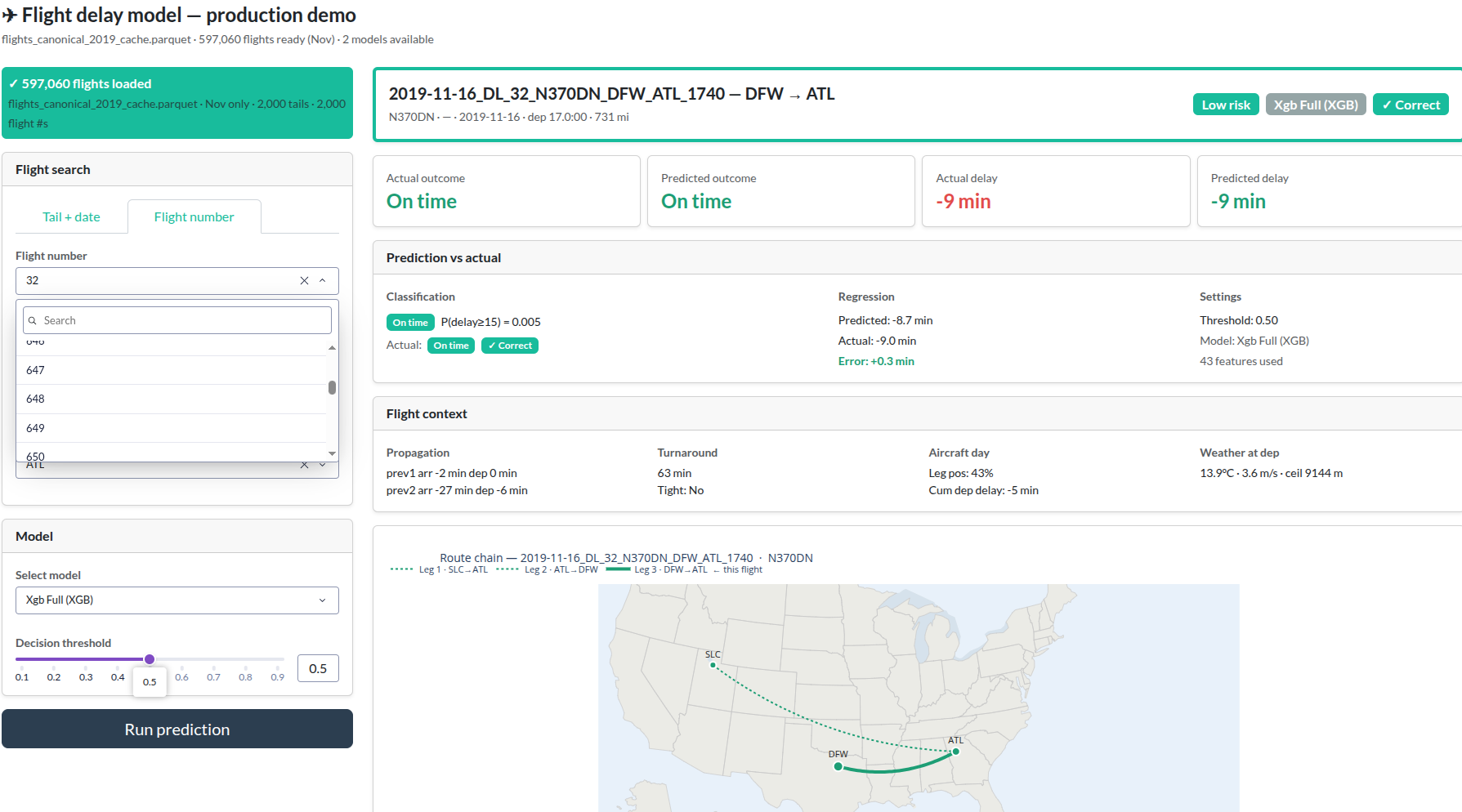
The companion AeroFlux prototype showcases real-time flight delay intelligence, model predictions, propagation chains, and interactive maps—prototyping a digital-twin view of the network.
View the Full Interactive Study
Open the interactive project site on GitHub Pages
The full site includes the data pipeline walkthrough, ML workflow notebooks, model diagnostics, the AeroFlux interactive prototype, and the final paper.